News

An archive of SEECOM conferences, events and activities.

Public communication in times of global uncertainty: SEECOM conference in Sarajevo

23 May 2023 · Sarajevo, Bosnia and Herzegovina

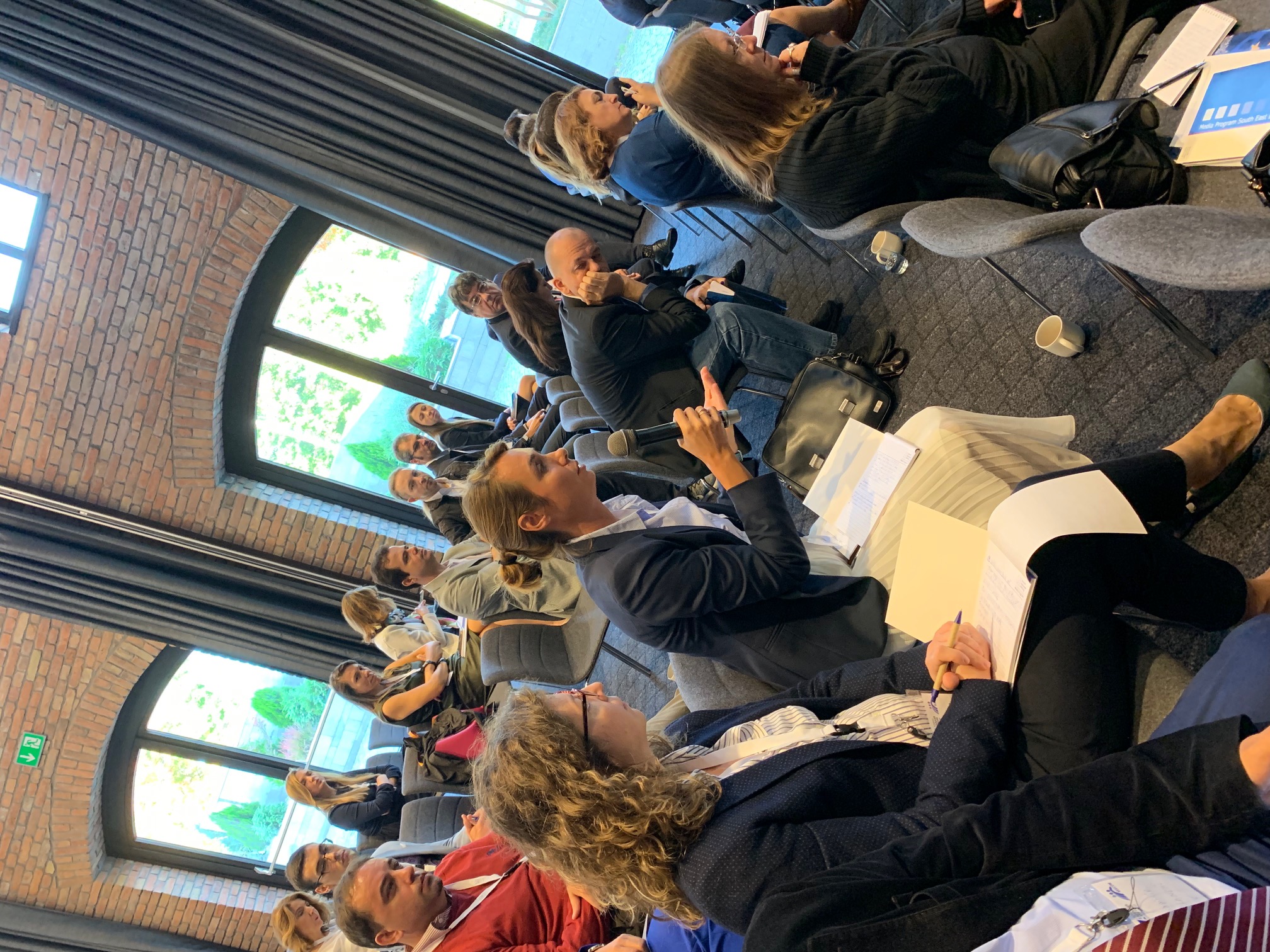
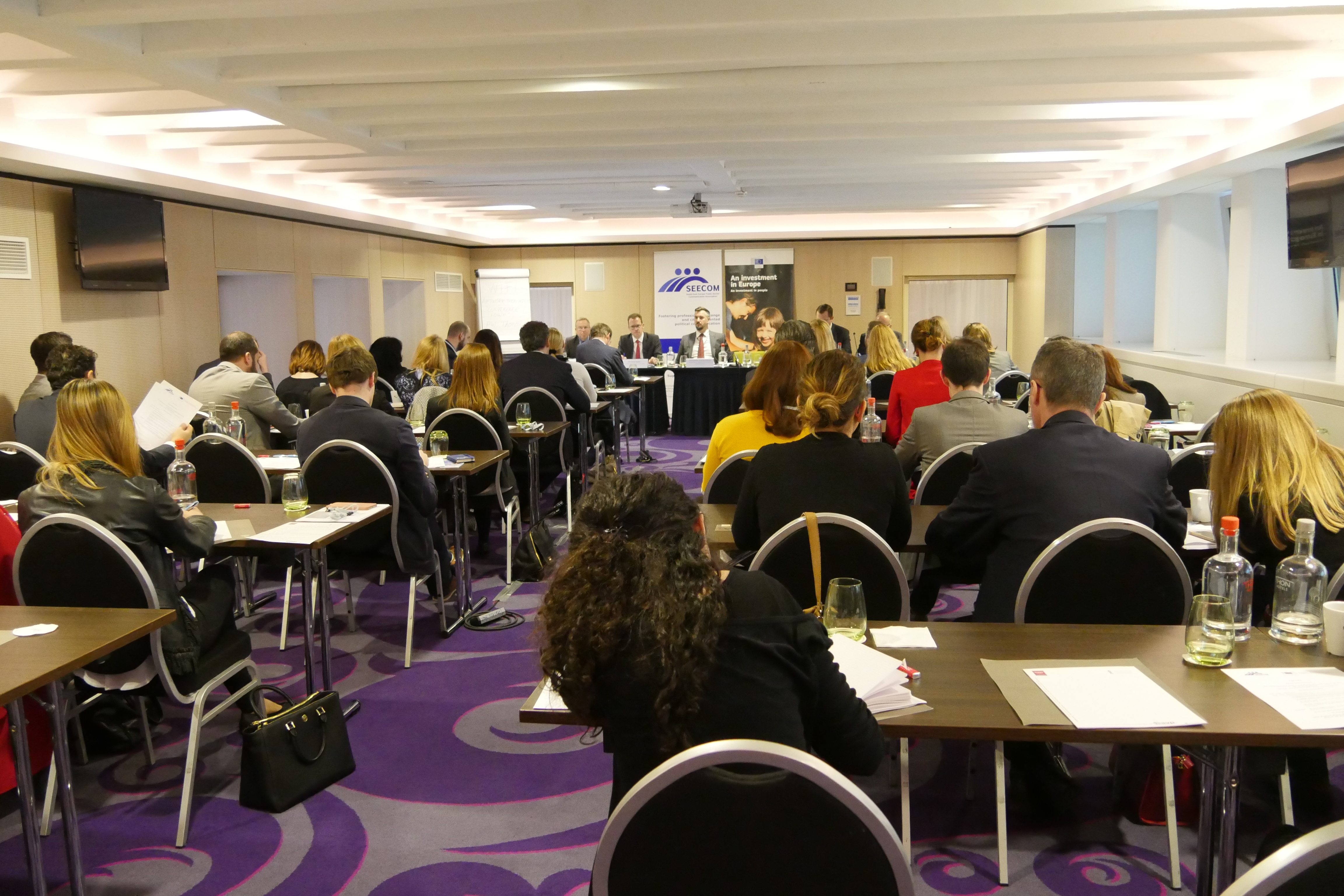
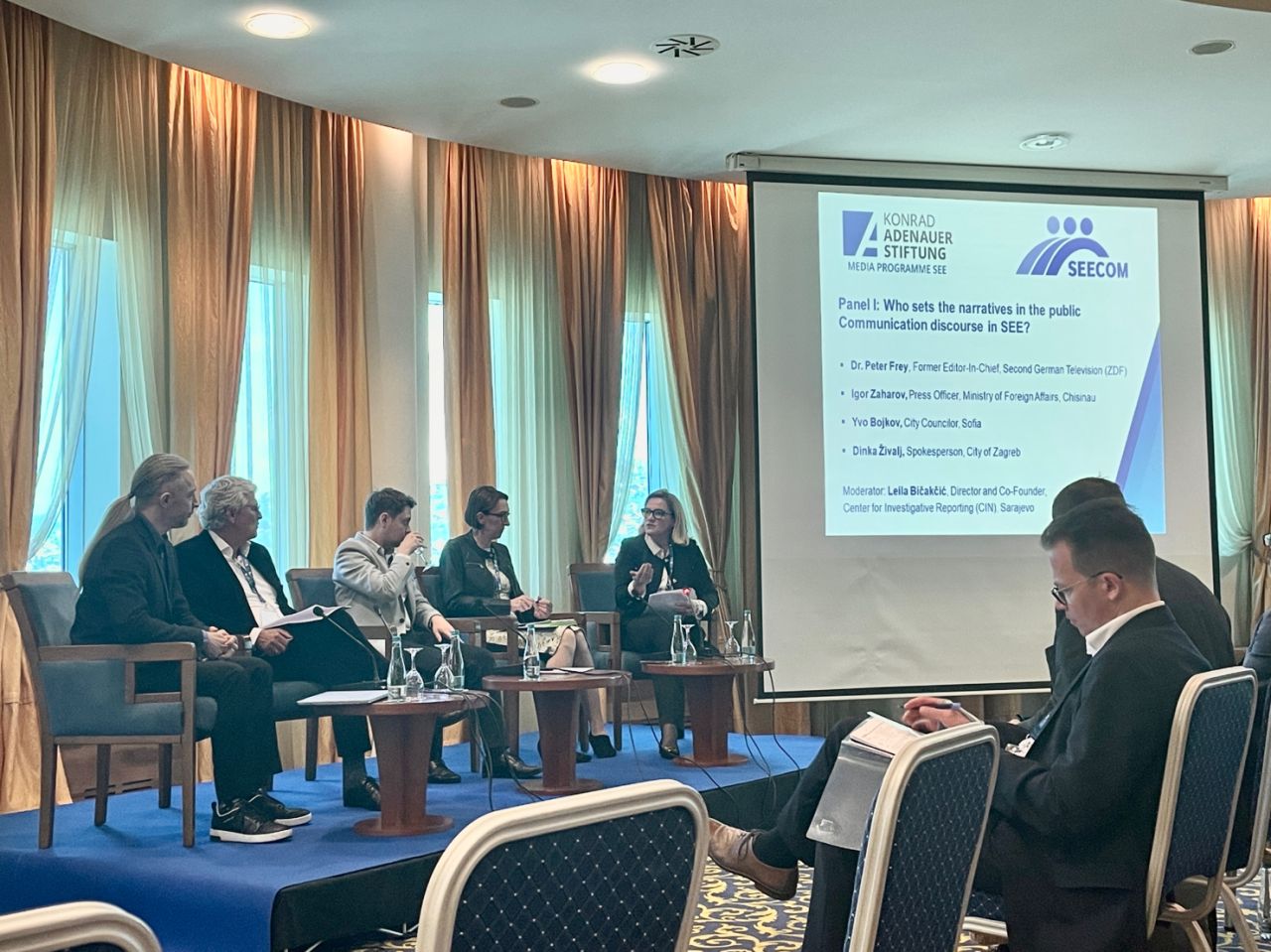
Participants at the SEECOM conference in Sarajevo in 2023
SEECOM conference, Sarajevo, 2023.

The 11th South East Europe Government Communication Conference, titled Impact of Global Uncertainty on Public Sector Communication, took place in Sarajevo, Bosnia and Herzegovina, on 23 May 2023. The conference was organised by SEECOM and the Konrad-Adenauer-Stiftung Media Programme South East Europe.

The event examined the challenges facing public-sector communication amid overlapping health, economic and geopolitical crises, growing polarisation and Russia’s war against Ukraine. Discussions focused on crisis communication and campaigning, the role of public communicators in uncertain times, and cooperation between government communicators and journalists.

SEECOM conference in Zagreb examines public trust in times of clashing values

8 April 2022 · Zagreb, Croatia

The 10th South East Europe Government Communication Conference, titled How to earn public trust in the times of clash of values?, took place in Zagreb, Croatia, on 8 April 2022. It was co-hosted by SEECOM and the Konrad-Adenauer-Stiftung Media Programme South East Europe.

The conference brought together senior public sector communication officials from across South East Europe, EU officials and some of Europe’s leading public sector communicators and communication experts.

The participants discussed the challenges, opportunities and ways forward for public authorities in navigating an increasingly complex communication environment, marked by growing public disengagement and mistrust in democratic institutions.

The conference adopted the following conclusions.

Conference conclusions

Challenges

The return of war in Europe in 2022, in the form of Russia’s invasion of Ukraine, underlines the perils of taking core democratic values for granted, as well as the importance of earning and retaining public trust in those values and in democratic institutions.

The brutal reality of destruction in Ukraine reveals the actual objectives behind the years of targeted disinformation and state-sponsored propaganda campaigns.

This further accentuates the need for effective communication with and active engagement of citizens in protecting and advancing the democratic values of human dignity, freedom, equality, rule of law and respect for human rights.

The atrocities of war, blatant lies and sinister propaganda, sit in sharp contrast with and shed a completely new light on the European Union’s ongoing effort to engage citizens in a debate on Europe’s present-day challenges and future priorities, through the Conference on the Future of Europe.

However welcome and important the Conference may be for fostering meaningful communication with and engagement of citizens, the real value of this undertaking will be measured by the level of European citizens’ long-term trust in democratic institutions and support for shared values.

People tend to appreciate engagement opportunities to the extent they see purpose and results of their engagement. Democratic institutions should, therefore, be completely honest about the participation process, while carefully managing people’s expectations and always delivering on the promise of meaningful and impactful engagement.

To this end, communication needs to be an integral part of policymaking, as political follow-up remains vital for maintaining the credibility of the process and sustaining motivation for engagement.

In one important aspect, the dialogue on the future of Europe did not fully succeed in breaking the bubble. Namely, in the countries aspiring to join the EU, the involvement of future EU citizens in a debate about their own future was largely perceived as more of an afterthought, than an integral part of a well-structured process.

In cases when Europe is not delivering on its commitments, as in the notable case of North Macedonia’s EU accession bid, lack of political action inevitably cripples communication and seriously undermines the transformative power and credibility of the EU enlargement policy as a whole.

In addition, the urgency of Europe’s crisis response and recovery efforts poses a general risk of insufficient involvement of regional and local authorities and local audiences in policy dialogue and communication.

Opportunities

The Budva Declaration, SEECOM’s founding document and Europe’s first transnational declaration of core professional and ethical principles of public sector communications, is as relevant today as it was when it was first adopted back in 2012.

The past ten years have offered plenty of evidence that professional and ethnical institutional communication, as one that provides avenues for citizens’ impactful engagement in policymaking, is a powerful means of earning public trust for democratic institutions and securing long-term support for core democratic values.

Russia’s aggression on Ukraine has shed a completely new light on the relevance and value of public engagement as a way of giving people a say in how democratic institutions perform on their behalf. Public engagement not only enables institutions to keep track of citizens’ expectation and ensures that public policies are better tailored to people’s actual needs, it also allows citizens to demand change and brings greater transparency and accountability of democratic institutions.

It is, therefore, no wonder that one of the key takeaways from the Conference on the Future of Europe is that Europeans want more avenues for meaningful engagement and participation in EU policymaking. This input poses a major opportunity to make the bodies and institutions of the European Union more accountable, transparent and responsive and, therefore, more in tune with the views, concerns and needs of European citizens.

In the increasingly complex communication environment, marked by the clash of values, vibrant free press is an essential asset of any democracy. Journalists are never the enemies of institutional communicators, as both professions aspire to serve the public interest and as both are accountable to the citizens.

Civil society organisations and networks can be powerful allies in ensuring meaningful and impactful dialogue with citizens, which is especially relevant at the regional and local level.

Culture, including popular culture, holds great potential for rallying Europeans around their shared identity, values and future. Whenever a cultural product of an aspiring EU member state is recognised and appreciated within the Union, that recognition and appreciation inevitably reinforces pro-European sentiments among the people of that country.

Ways forward

In times of clash of values, communication about Europe should go back to basics, as people need to be engaged in a dialogue about the importance of a peaceful, democratic society for their lives, and the role that the shared European values play in this.

The Conference on the Future of Europe should herald many new opportunities for European citizens to have a greater say in what the Union does and how it works for them. It should allow for an open, inclusive, transparent and structured debate, and make it easier for European citizens to get involved in democracy, beyond the European elections.

The way European democratic institutions respond to Russia’s invasion on Ukraine will have a direct impact on the credibility and popular support for a united Europe. Therefore, the level of popular support for shared European values will be largely dictated by the level of Europe’s policy support for those values.

Engaging Europeans in how Europe works and delivers for them is a vital step in making European democracy fit for the future. The best way of planning for the future is to discuss it with young people. In the EU accession countries, in particular, meaningful and impactful dialogue with the youth should be part of an integrated policy and communication response to the fact that the growing number of young people are leaving those countries impatient with the slow pace of EU accession process.

In times of crisis, speed of institutional communication is of essence, in order to be able to limit the effects of disinformation. Proactive approach of public institutions in engaging citizens in a dialogue on core democratic values is a vital tool in countering disinformation narratives.

To ensure meaningful and impactful engagement of citizens in key public policy issues, institutions need to ensure impactful presence through many channels of communication, which requires continued investment in professional development of institutional communicators.

For any meaningful dialogue to take place, mutual respect between the parties involved is vital. Which is why decent and respectful institutional communication is of essence. Institutional communication must always be truthful and institutions should never pretend that disruptive ideas do not exist, however ludicrous they may appear to be. If they are prominent and impactful enough, they need to be addressed.

At the same time, communication about the European Union should manage people’s expectations. The EU’s complexity and its intricate and often lengthy process of consensus building should be honestly acknowledged.

Senior public communicators, journalists, academics and civil society leaders from South East Europe met in Tirana to discuss communication in times of COVID-19

25 June 2021 · Tirana, Albania

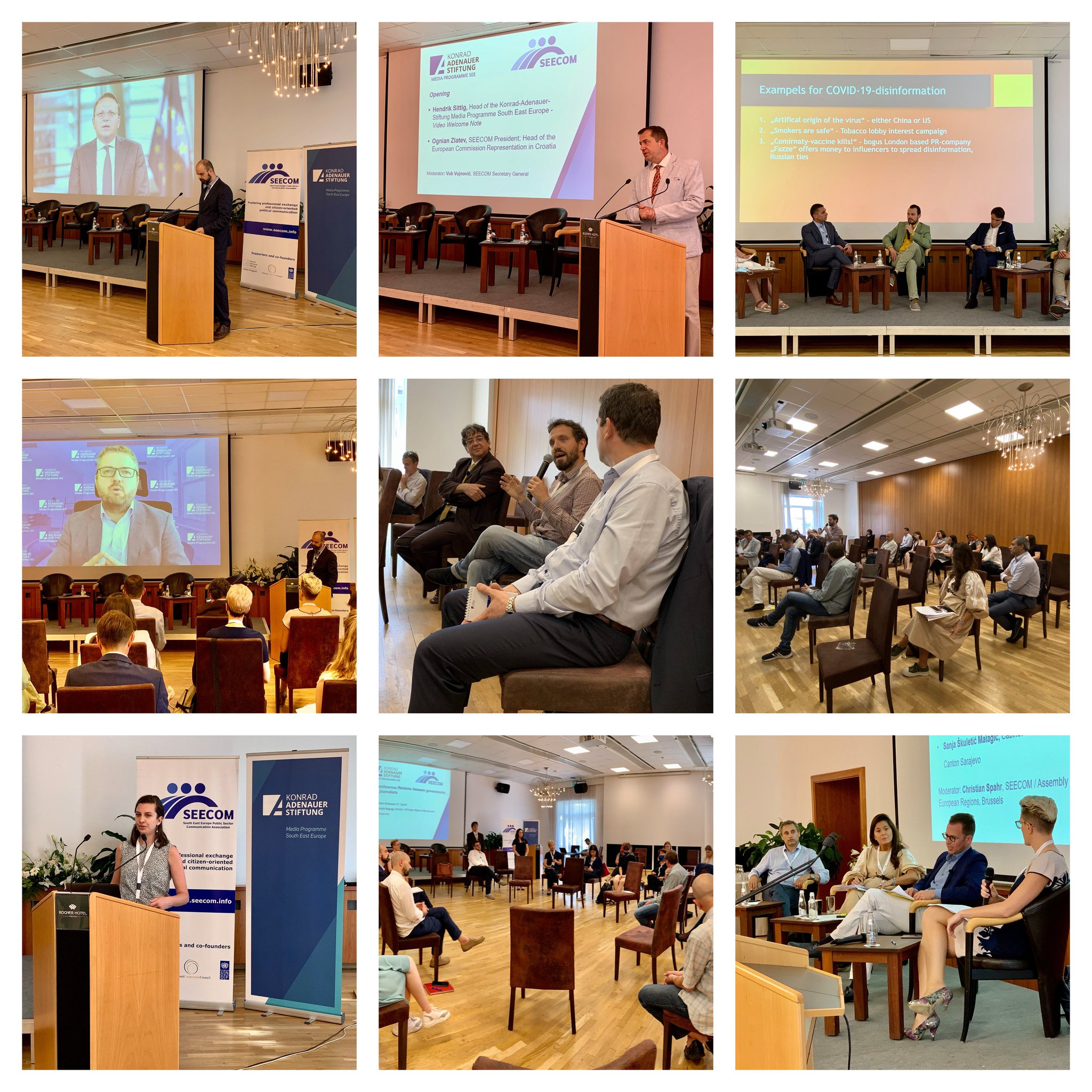
Participants at the SEECOM conference in Tirana in 2021
SEECOM conference, Tirana, 2021.

The 9th South East Europe Government Communication Conference “Communication in times of the pandemic: Protecting lives, values, and togetherness”, co-hosted by SEECOM and KAS Media Programme South East Europe, took place in Tirana on 25 June 2021.

The event brought together senior public communicators from South East Europe with some of the region’s leading journalists, academics and civil society leaders, for an exchange of views on the challenges, opportunities and ways forward for public sector communication in times of the COVID-19 pandemic.

EU Commissioner for Neighbourhood and EnlargementOlivér Várhelyi addressed the conference through a keynote video message. “Joining the EU brings huge benefits and the latest Eurobarometer shows that trust in the EU is the highest in 11 years. Even if other players have interest in the region, only the EU perspective based on shared values offers to transform societies and economies in a comprehensive and sustainable way to build their long-term prosperity, stability and resilience,” said the Commissioner.

The conference reached the following conclusions.

Conference conclusions

Challenges

The COVID-19 pandemic has proved fertile ground for disinformation, populism and different forms of extremist narratives, which threaten to weaken public trust in democratic institutions, national authorities, the European Union and traditional quality media. Narratives perpetuated by national politics and third-party interests tend to downplay the EU’s role in handling this unprecedented health and economic crisis. The fact that EU-related reforms are sometimes difficult and may not always produce immediately visible benefits can be misused, in the short term, to generate negative perceptions in the enlargement region.

Crisis communication in the region is rarely scientifically driven and strategically focused on research and audience insight. Instead, it is often handled by politicians in line with their current agendas, which contributes to further polarisation of the already deeply divided societies. Although popular support for the EU is relatively high in most countries of the enlargement region, support for the EU is still largely contextualised through the prism of national politics.

The COVID-19 crisis has seriously undermined media sustainability in the Western Balkan region, bringing print media, in particular, to the verge of economic collapse. The media environment remains highly polarised across the enlargement region, with the media widely perceived as being either pro- or anti-government. Declining reporting standards and a media environment dominated by tabloid journalism have made older people increasingly more susceptible to conspiracy theories and anti-vaccine narratives.

Despite the fact that young people’s lives, education and livelihood prospects have been particularly seriously affected by the COVID-19 pandemic, their views are still insufficiently taken into consideration in the process of designing and implementing policy responses to the crisis.

Opportunities

According to the latest EU barometer, the image of the EU is best today since 2009 and people’s trust in the EU is the highest in 11 years. This suggests a high level of public awareness of the benefits of EU membership, as well as appreciation for the EU’s response to the COVID-19 crisis.

The power of the EU enlargement policy to bring long-term prosperity, stability and resilience to the Western Balkan societies and economies is unmatched by any other offer that might be on the table for the region. This transformative power of the EU enlargement policy, based on shared values, is a major communication asset.

The EU’s prompt and substantial support to the enlargement region in times when EU member states themselves were faced with an unprecedented health and economic crisis tell a real and compelling story. Those facts need to be used and the EU’s strong presence and visibility on the ground is a vital tool in winning the hearts and minds of people in the enlargement region. To be successful in this public diplomacy effort, the EU needs the engagement of national authorities, in particular government communicators, who are crucially placed to help secure broad support for the EU and the accession process among the people in the region.

The role of citizens should not be disregarded in times of crisis. Instead, citizens should always be considered as part of the solution, and remain engaged in crisis communication efforts, rather than being kept at the receiving end of public communication. Policy of transparency, dialogue and compromise is conducive to more trust in government, and no communication practice, however advanced or well-polished, can substitute for lack of accountability and meaningful participation in policy making.

Democracy is not reserved for capitals – it needs to work for all people in all regions and communities.

However, traditional town hall meetings with speeches and Q&A sessions are simply not sufficient in the digital era. Regional administrations need to be able to include citizens in policymaking by creating online feedback tools and procedures to make sure that the input by citizens can feed into the policy making process.

Ways forward

In times of crisis, perception can be even more important than facts, which makes it essential for crisis communication to be quick, consistent and open. Consistency, in particular, is key in sustaining public trust in institutions and support for crisis policy response. In addition, the authorities that provide vital information in times of crisis are responsible for complying with the highest standards of ethics and expertise.

Rather than relying predominantly on the narrative of imminent anti-EU geopolitical threats as a case for EU enlargement, the candidate countries should project an image of readiness to assume all the rights and responsibilities of EU membership.

In order to be able to tackle disinformation and anti-EU narratives more effectively, the authorities in the enlargement region need to invest more coordinated efforts in the areas of general education, media literacy and civic education. Education, both formal and informal, is key to building social resilience and ultimately countering disinformation. To this end, closer coordination and deeper synergies are needed between the EU’s strategic communication efforts and those of the national governments in the enlargement region.

Instead of focusing solely on debunking disinformation, looking into the reasons for its effectiveness will reveal the people’s perceptions, concerns and fears, which need to be addressed through public communication and policy efforts. In countering disinformation, the authorities should never aspire to eliminate dissonant views, but rather provide for a genuine dialogue and meaningful interaction between “resonance” and “dissonance”.

In order to ensure that citizens are capable of making informed democratic choices, building at least a certain level of mutual trust between journalists and government communicators is essential. Promoting the highest ethical and professional standards, as well as solidarity and peer exchange are major steps towards greater accountability and professionalism in both professions. For public authorities, finding ways to engage young people in key policy issues is vital in sustaining their trust in democratic institutions and support for shared European values. Civil society organisations are indispensable as partners in reaching out to the citizens, attracting their interest and getting them engaged in policy design and implementation.


SEECOM conference in Belgrade addresses government communication in the age of populism

18 October 2019 · Belgrade, Serbia

Participants at the SEECOM conference in Belgrade in 2019
SEECOM conference, Belgrade, 2019.

Around 70 government communicators, journalists and editors from South East Europe, together with EU officials and communication experts, participated in the 8th South East Europe Government Communication Conference, titledGovernment Communication in the Age of Populism, in Belgrade, Serbia, on 18 October 2019.

Participants exchanged experiences, good practices and lessons learned on how public institutions can gain citizens’ attention, trust and support for pro-European policies in a communication environment crowded with simplistic populist and anti-European messages.

Since the first conference, held in Budva, Montenegro, in 2012, the annual event has been organised by SEECOM and the Konrad-Adenauer-Stiftung Media Programme South East Europe.

The conference was followed by the SEECOM Members’ Assembly, which re-elected Ognian Zlatev, Head of the European Commission Representation in Zagreb, as SEECOM Chairman. The Assembly also elected the members of the Steering Committee: Christian Spahr, Dinka Živalj, Nebojša Regoje and Ivana Đurić. Vuk Vujnović was given another three-year term as SEECOM Secretary General.

The conference adopted the following conclusions.

Conference conclusions

Challenges

The failure to set the date for the opening of accession talks with North Macedonia and Albania has seriously undermined the EU’s credibility and reputation in South East Europe. In some cases, it has even led to claims that the most powerful anti-European narrative in the region is actually coming from Brussels. Therefore, the political decision of one member state is clearly affecting public attitude towards the whole Union and its institutions.

Populism is not a new phenomenon, nor is it uncommon in modern democracies. Populism thrives with the weakening of democratic institutions and it goes hand in hand with disinformation. The simplistic appeal to people’s concerns and fears makes populist messages and disinformation very effective and engaging, especially on social media.

A major challenge in combating disinformation is the lack of regulation and tools to respond effectively to what is going on social media. The countries of South East Europe, due to their small markets, are particularly disadvantaged when it comes to getting global tech and social media companies to support their anti-disinformation efforts.

Another big hurdle to effective government communication is an illusion that communication took place. This happens when public institutions expect to engage their audiences by simply broadcasting their messages, without offering their audiences any opportunity for meaningful engagement and without ever measuring the impact of their communication efforts. This is a particularly notable challenge when it comes to communicating with the excluded segments of the society, which are most likely to be influenced by disinformation and disruptive narratives.

There is a major communication deficit between journalists and government communicators in South East Europe. The relationship between government communicators and journalists is rarely based on the shared responsibility to serve the public interest, but is much more likely to be affected by their, real or perceived, political bias.

In worst cases, media are seen as politically biased, either in favour or against government, while government communicators are perceived as serving the interests of political elites rather than the public. As far as respect for professional and ethical standards is concerned, there seems to be strong interdependence between how governments communicate and how media report about their policies.

Opportunities

Public institutions can actually learn a lot from the communication approach of some populist movements, when it comes to clarity of messages and attentiveness to the needs and concerns of their audiences.

Capturing citizen’s attention in a crowded information and media ecosystem relies heavily on a government’s ability to understand and know their audience. Building the professional capabilities of government communicators and allowing them access to robust audience insight is therefore critical for any strategic communication effort.

Contribution of government communications to the principles of open government is underexplored. There is strong evidence suggesting that more open and more engaging government communication leads to better policies that are more responsive to people’s actual needs and concerns. The OECD’s forthcoming first global report on government communications will provide important insights in this respect.

The topic of Europe and European Union is more present in the media in South East Europe today than ever before. Both government communicators and media should seize this opportunity to raise awareness and understanding in their societies of the actual purpose, values and benefits of the idea of a united Europe.

The high voter turnout and the results of the 2019 European Parliament election proved that effective and fact-based institutional communication is capable of competing with populism and disinformation. Therefore, investing more effort is bound to produce even better results.

In particular, public service broadcasters should be able to invest more robust efforts to combat disinformation and build resilience of the population to extremist narratives.

The media are the government’s most important partner in fighting populism and disinformation. There is an underexplored potential for government communicators and journalists to work more closely together on specific issues and practical projects in order to explain to the people the true relevance and benefits of pro-European reforms and policies.

Ways forward

Managing public expectations in the EU aspirant countries is a major task for EU communications, as they need to explain in straightforward and plain terms the complexities of formulating the collective will of all member states. It needs to be made clear that the EU’s failure to reach a consensus about the opening of accession talks with North Macedonia and Albania reflects the current political reality, rather than the EU’s long-term vision of a united Europe.

As the EU’s complicated internal position on enlargement is clouding its message in South East Europe, when communicating pro-European reforms and policies, public institutions in the region should go back to basics, by bringing closer to the people the core values and benefits of a united Europe.

It is not possible to debunk every single piece of disinformation, therefore improving government communication capabilities and building resilience to disinformation, including through greater investment in media literacy, is critical.

In the region of South East Europe, the starting point for government communications should be the concerns and interests of citizens, rather than political and administrative processes and procedures. A strong focus in communications must be on the rule of law, as the core value and a precondition for the European quality of life.

In order to bring public policies closer to the people in the increasingly complex communications environment, government communicators need to be able to produce prompt, clear, consistent and truthful messages and narratives in a real and dynamic communication context. Although institutional communication must be based on facts, it must never be boring.

Instead of relying solely on broadcasting public policies, it is critical for government communications to allow for genuine and honest interaction with their audiences – to listen as well as speak, to open opportunities for conversation and to be able to respond to people’s concerns and questions.

By working together more closely with civil society organizations government communicators will have better opportunities to engage citizens in public policies, while advancing the open government principles of transparency, accountability and public participation.

In particular, if they are to compete for public attention with the simplistic messages and narratives of populism and disinformation, public institutions need to be able to present policies in the context of human interest stories. This is an area where government communicators and journalists can work together much more closely and more productively in the best interests of both professions.

Greater adherence to ethical rules and professional standards will help build a more solid partnership and cooperation between government communicators and journalists and enable them to work together more productively in the public interest. Therefore, there is a strong need to build the professional capabilities of both journalists and government communicators in South East Europe and create practical cooperation opportunities based on shared commitment to public good.


SEECOM round table in Brussels explores how to boost public support for EU enlargement

5 February 2019 · Brussels, Belgium

Participants at the SEECOM round table in Brussels in 2017
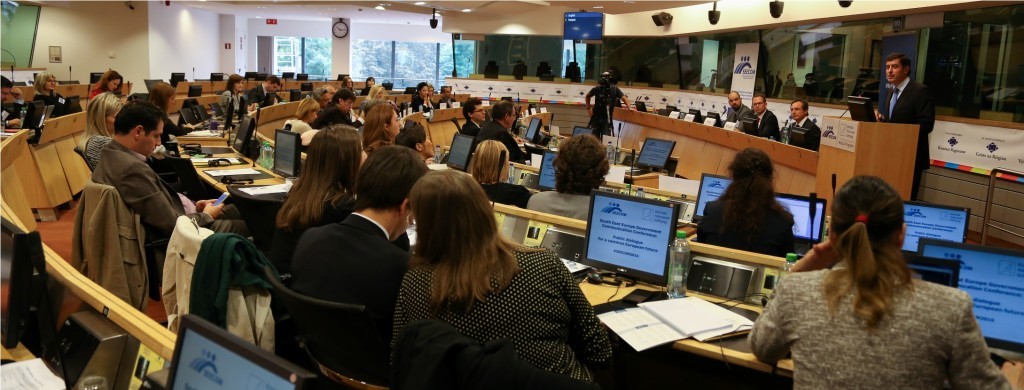
Participants at the SEECOM conference in Brussels in 2016
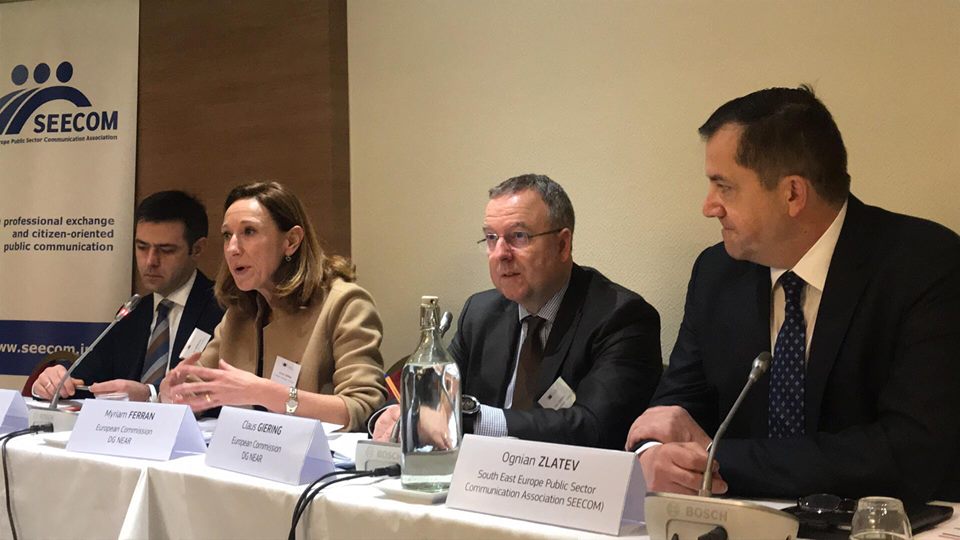
Participants at the SEECOM round table in Brussels, February 2019.

A round table discussion on public support for EU accession of the Western Balkans took place in Brussels on 5 February 2019. It brought together more than 70 senior public communicators from Western Balkan governments and EU institutions, policymakers, experts, journalists and civil society representatives to discuss the challenges and opportunities of communicating the region’s European perspective.

The event was hosted by SEECOM, in partnership with the European Fund for the Balkans and the European Commission’s Directorate-General for Neighbourhood and Enlargement Negotiations (DG NEAR).

Myriam Ferran, Director for Strategy and Turkey at DG NEAR, opened the event alongside Ognian Zlatev (SEECOM) and Igor Bandović (European Fund for the Balkans). Two panel discussions followed, bringing together perspectives from local governments, EU Member States and institutions, think tanks and the media.

The first panel focused on how Western Balkan governments communicate about the EU accession process and the role of the media. The second examined how EU enlargement and the European perspective of the Western Balkans are communicated to citizens in EU Member States.

The main ideas from the discussions are summarised below.

Round table conclusions

Opportunities

The historic Prespa Agreement, as a major good news story for the Western Balkans, provides a significant boost to the region’s reputation and inspires greater enthusiasm and energy for its EU perspective.

In addition, the series of small achievements that all EU aspirants are making in transforming their societies and improving people’s lives through EU accession reforms also creates plenty of opportunity for engaging citizens in the EU accession reforms.

Western Balkan citizens are as European as EU citizens. In this context, the rich cultural heritage and the contemporary culture of the region are major communication assets, speaking convincingly about the European identity of the peoples of the Western Balkans.

Professional exchange among public sector communications is invaluable for sharing best practices and lessons learned about the meaningful engagement of citizens in the EU integration affairs.

Romania’s decision to keep enlargement high on the EU Council’s agenda during its Presidency creates fertile grounds for any efforts aimed at boosting public support for the European perspective of the Western Balkans.

The forthcoming EU summit in Sibiu is an important opportunity to set a clear vision for the future of Europe. Involving aspiring EU members from the Western Balkans in the event would be a major symbolic action, sending a powerful message of the credibility of the vision of united Europe.

The 15th anniversary of the so-called ‘big bang’ enlargement is a good occasion to raise awareness of the benefits of EU enlargement for EU citizens.

Challenges

Throughout Europe, public institutions are struggling to devise effective factually based communications capable of engaging citizens in an increasingly complex media environment, which faces propaganda and disinformation challenges.

The credibility of the EU enlargement policy is put in doubt by the length of the accession journey of the aspiring EU members in the Western Balkans.

On the one hand, effectiveness of communication is clearly directly dependent on the success and implementation of reforms in the enlargement region. In other words, a lack of reforms can never be compensated by communications.

On the other hand, despite the economic and societal value and importance of enlargement, as the EU’s most transformative policy, the efforts that many EU member states invest in communicating enlargement domestically remain relatively low.

In the region, there is a perceived discrepancy between the requirements for EU integration and current reality which in some cases even leads to opinion that ‘the EU is pretending to enlarge, while the Western Balkans are pretending to reform’.

A majority of citizens in all aspiring EU member states are in favour of joining the Union, although many of them (26% on average in the Western Balkans, according to the RCC Balkan Public Barometer 2018) do not believe that membership is ever going to happen.

Media are widely disengaged, as they feel that reporting about EU affairs is not appealing to their audiences. As a result, they are letting the interests of political elites shape the public debate about the EU.

Consequently, EU bashing continues in national politics in both EU member states and the Western Balkans.

Generally, Western Balkan countries have a poor international image and the stigma and prejudices associated with the region are likely to be exploited by the nationalist and extremist movements in the run up to the European Parliament elections.

The diversity of political views about the EU enlargement policy inevitably leads to ambiguities in communications both in the EU and in the region.

Government communication services in the Western Balkans are understaffed and in need of training, while professional exchange opportunities are scarce.

Ways forward

Although EU institutions cannot be expected to drive the Europe-wide communications efforts, their initiative and support are invaluable in encouraging and facilitating professional exchange and coordination of communication efforts across Europe, especially in the Western Balkans.

Given the vast diversity of political views in Europe, going back to basics when communicating EU enlargement could be an important way forward. Although different environments require different tactics, communications about the EU should be based primarily on the fundamental values that bring together the EU member states and candidate countries.

Joint efforts are needed in addressing the shared challenges to the credibility of the idea of a united Europe. It is important to revamp the image of the Western Balkan. The countries of the region clearly need to work together, since a cluster perception requires a cluster response.

Communications about the EU cannot rely exclusively on traditional media or traditional communication styles. Instead, communicators need to provide citizens with engaging facts, knowledge and understanding of important issues and the sense of shared European identity, through a mix of information, education and advocacy efforts. Sustained efforts to engage citizens directly in communications efforts are absolutely vital.

On the other hand, media in the Western Balkans should focus more on storytelling, explaining why EU integration matters, and act as EU accession watchdog, calling governments to account for reform results.

The EU needs to be made more relevant to people, and communication needs to be focus on benefits and values rather than procedures and processes. It is vital that citizens are approached with simple, clear and honest messages. Governments and EU institutions should adopt the narratives of hope and optimism, rather than fear.

Having a commissioner for enlargement in the next European Commission would be an important symbolic action adding credibility to the EU enlargement policy.

Polls show that EU citizens support joint EU actions on a number of key issues, such as terrorism, migration, competitiveness of Europe, etc. The fact that the Western Balkans is needed at the table when those issues are considered represents an important communication opportunity.

Western Balkans is in many ways already part of the EU. For example, European citizens are already putting their lives in the hands of the flight controllers from the region. Therefore, the legitimate concern of certain member state should not prevent them from reciprocating the credibility of the candidate countries’ commitment to a united Europe.

More efforts need to be invested in cultural and people-to-people exchange between the EU member states and the enlargement region.

Developing the professional skills of government communicators in the Western Balkans is a prerequisite for effective communication about the region’s EU perspective.


SEECOM conference in Sarajevo explores a shared European identity

12 October 2018 · Sarajevo, Bosnia and Herzegovina

Participants at the SEECOM conference in Sarajevo in 2018
SEECOM conference, Sarajevo, 2018.

The 7th annual South East Europe Government Communication Conference, entitled Beyond geography: Europeans in search of shared identity, took place in Sarajevo, Bosnia and Herzegovina, on 12 October 2018.

The conference brought together senior public-sector communication officials from South East Europe, EU officials and some of Europe’s leading public-sector communicators and communication experts. Participants discussed the challenges, opportunities and ways forward in building a stronger shared European identity and communicating the idea of a united Europe.

The event was co-hosted by the South East Europe Public Sector Communication Association (SEECOM) and the Konrad-Adenauer-Stiftung Media Programme South East Europe.

The key discussion points are set out in the conference conclusions below.

Conference conclusions

Challenges

The concurrent crises affecting the EU are feeding populist and extremist political movements across the continent, which are challenging the very idea of a united Europe. As a result, important political voices within the European Union are calling for internal reforms and consolidation before any further enlargement of the Union can be considered. In addition, in many countries, EU bashing is a regular practice across the political spectrum.

On the other hand, the increasingly complicated geopolitical context in South East Europe and the ever more complex communications environment, including cyber-security threats, disinformation and propaganda campaigns and the deterioration in media standards, are making it very difficult for the governments of the enlargement countries to communicate about European integration.

A vast majority of EU Member States are hardly investing any effort to communicate to their citizens the importance and benefits of EU enlargement, even if the policy itself involves spending billions of Euro of European taxpayers’ money.

The European Union is facing a crisis of credibility, as European citizens in both – the EU and the enlargement countries – are largely disinterested and disengaged when it comes to EU affairs. As for the media, the EU-related topics are perceived as boring news that has no potential of getting the audience’s interest or are seen as issues that concern only the governments and Brussels elites and serve their PR interests.

Communication capacities of Western Balkan governments are generally quite weak, as many government communication offices are understaffed and in need of training and professional development. This hinders the capability of Western Balkan governments to capture the interest of their citizens and get them engaged in the EU integration affairs.

Opportunities

The Bulgarian Presidency of the EU Council put the Western Balkans back on the EU agenda as a major policy topic by hosting the first EU-Western Balkans summit after 15 years.

Furthermore, Austria retained the EU perspective of the Western Balkans among the key priorities of its EU Presidency, while the next EU Presidency, Romania, also announced that it would keep EU enlargement high on the agenda. Even if not all EU Member States are equally enthusiastic about the prospect of enlarging the EU to the Western Balkans, generally speaking the focus on the Western Balkans has never been greater.

Third-party geopolitical interests and ambitions in the Western Balkans have raised awareness throughout Europe of the risks of contesting narratives and values finding fertile ground in the EU’s most immediate neighbourhood.

The migration crisis and the constructive role played by the Western Balkan countries has shed more light on the region’s strategic relevance for the EU. Contributing to the EU Member States’ efforts to resolve this major humanitarian and political issue could help improve public perception of the Western Balkans within the EU.

Ways Forward

There is a story in every project and every policy. Therefore, institutions in the Western Balkans should work to inspire greater public interest in and support for EU integration, by producing easy to understand and engaging stories. It is unreasonable to expect the media to discover interesting stories in thousands of pages of complex policy and project documents. Therefore, it is the job of government communicators to produce such ‘positive stories’ and make them available to the media.

The Western Balkan governments need to build capacities to communicate in a credible and effective way. To this end, professional exchange among communicators is invaluable.

Public participation is a powerful tool against scepticism. Citizens may not be interested in hearing about public policies, but they are much more likely to get engaged if they have a say in how policies are designed and implemented. In addition, public participation informs decision-making and helps governments to create policies that are better tailored to citizens’ actual needs, expectations and concerns.

In order to demonstrate the region’s relevance and value for EU citizens, new messages are needed on what enlargement countries have to offer to Europe. However, all communication efforts need to be driven by policy actions, as actions speak louder than words.

The EU and its institutions can provide the Member States and the candidate countries with the tools and coordination mechanisms for more effective and more synchronized communications, but nothing can replace the efforts of national governments to communicate with local audiences. The approach should be bottom-up. Initiatives, audience insight and local expertise should come from national governments and Brussels should provide the support and tools to facilitate synergies.

Engaging young people is vital for sustaining popular support for a united Europe. To this end, investments in media literacy and civic education are critical in building young people’s capacity for critical thinking and resilience to disinformation. Formal education is highly important for inspiring the sense of shared European identity and instilling the idea of a united Europe, as an unprecedented project of spreading peace and prosperity on the whole European continent.


SEECOM’s 2017 conference in Berlin discusses ways of reconnecting the EU with its citizens and neighbourhood

13–14 October 2017 · Berlin, Germany

```astro
Participants at the SEECOM conference in Berlin in 2017
SEECOM conference, Berlin, 2017.

The SEECOM 2017 annual plenary conference, entitled Public Dialogue in Europe: Reconnecting the EU with its citizens and neighbourhood, took place in Berlin on 13–14 October 2017.

The event featured discussions between prominent public communication practitioners and experts from both sides of the Atlantic and senior officials from EU institutions, Member States and the EU enlargement countries, including, among others, MEP David McAllister, Deputy Secretary General of the Konrad-Adenauer-Stiftung Dr Gerhard Wahlers, Deputy Director-General at the European Commission’s DG NEAR Maciej Popowski, Montenegrin Minister of European Affairs Aleksandar Andrija Pejović, Serbian Minister of European Integration Jadranka Joksimović and Croatian Assistant Foreign Minister Boris Grigić.

The participants addressed questions including how to win popular support for EU enlargement in the Member States and enlargement countries, how a united Europe as a community of values should stand up to propaganda and disinformation, and what new campaigning trends meant for governments.

At the conference, the Konrad-Adenauer-Stiftung Media Programme South East Europe presented a newly published book: Reconnecting with citizens – from values to big data: Communication of governments, the EU and political parties in times of populism and filter bubbles.

The event was co-hosted by the Konrad-Adenauer-Stiftung Media Programme South East Europe and SEECOM, in partnership with the European Commission’s DG NEAR.

The conference reached the following conclusions.

Conference conclusions

Challenges

Although the European Union is by far the largest contributor of development assistance in South East Europe, the public perception in certain enlargement countries is that some third countries contribute more. Furthermore, the visibility and public credit that the European Union receives in the enlargement region is not in proportion to the volume of the EU’s investment.

The level of public support for enlargement in the EU Member States remains disturbingly low, which highlights the pressing need for more coordinated action to explain to European citizens the importance of the EU enlargement policy, as a sustained effort to spread peace, prosperity and democracy throughout the European continent.

In an increasingly challenging environment of disinformation, European governments are struggling to engage citizens in a dialogue on a united Europe. This challenge is also present in South East Europe, where third parties are working systematically to offer alternative narratives, values and perspectives to the citizens of the region.

Although propaganda and disinformation existed before, the new geopolitical circumstances, the advance of information technology and the fundamentally changed media landscape have made those challenges much more impactful and much more difficult to discern.

Regardless of the mounting evidence of the clear means and clear targets of the ongoing anti-European communications efforts, there doesn’t seem to be a common understanding in South East Europe, and Europe as a whole, of the presence, extent and perils of this new form of information warfare.

Opportunities

The latest State of the Union Speech by President Juncker has provided a powerful boost to the enlargement process and the much needed encouragement for quicker reforms in the accession countries, offering for the first time in many years a timeframe for enlargement.

With the recent election victories of pro-European forces in a number of key EU Member States, the mainstream of European politics is clearly shifting in favour of a common European future. This creates a favourable political environment to rekindle public enthusiasm for a united Europe through effective public communications.

Reputation, credibility and public trust are pivotal for the ability of governments and public institutions to counter disinformation by effective communications. The reputation and credibility of the European project is best earned by showing the added value of the EU on the ground in local communities. The very tangible benefits of the Berlin Process, as an effort to reconnect Europe’s South East with the rest of the continent, in terms of transport, energy and trade, as well as to boost regional ties, youth and civil society exchange, represents a major communication asset to this end.

Although the pandemic problem of credibility of both traditional and new media and the surge of fake news and disinformation raises a serious communication challenge, it also represents an opportunity for governments to re-establish themselves as trusted sources of public information, especially through direct communication with citizens. This, however, requires adherence to the highest ethical and professional standards of government communications.

Ways forward

There is no quick fix to anti-European propaganda, fake news or disinformation. Instead, sustained and coordinated actions by EU Member States, enlargement countries and EU institutions are required in order to build the resilience of European societies, through a combination of political messaging, engagement with local communities and civic education efforts.

However, in order to reconnect the EU with its citizens and neighbourhood, political messaging at EU and national levels will not suffice. Instead, effective communication requires sustained dialogues at local level and active engagement with local communities, civil society and businesses in explaining how and why a united Europe matters.

The focus of any strategic communications effort should be on people and the specific issues that they care about, rather than on institutional agendas, because people follow issues, not institutions. Opening a meaningful dialogue with a specific community on an EU-related issue that matters to them is a major step in making them care for and support the idea of a united Europe. Fostering professionalism and freedom of the media as a key partner for this dialogue is of paramount importance.

Government communications should focus more on the added value, visible results and concrete benefits that a united Europe holds for citizens, to which end the Berlin Process offers extremely valuable assets. Furthermore, developing service-oriented communication which centres on the provision of useful and reliable information about public services and enables citizens’ feedback, serves to build public trust in government policies.

Communications on Europe need to be able to capture people’s attention and engage them over specific issues. Involving citizens and communities more directly in the programming of the EU’s financial assistance to the enlargement countries would raise more public awareness and underscore the relevance of the EU integration process. In this context, integrating communications into the programming process for pre-accession financial assistance by the European Commission is highly commendable, as well as exploring options to increase governments’ capacity to communicate about the EU in the region.


SEECOM round table in Brussels discusses the Western Balkans’ European future

31 March 2017 · Brussels, Belgium

Participants at the SEECOM round table in Brussels in 2017
SEECOM round table, Brussels, 2017.

A round table discussion on EU enlargement policy and the European future of the Western Balkans, with a focus on the importance of communication, was organised by SEECOM in partnership with the European Commission’s Directorate-General for Neighbourhood and Enlargement Negotiations (DG NEAR) in Brussels on 31 March 2017.

The event brought together around 60 government officials, communicators and communications experts from the Western Balkans, EU institutions and Member States. They discussed the challenges and ways forward in communicating the European future of the Western Balkans, both in the enlargement region and in EU Member States.

The speakers included Aleksandar Andrija Pejović, Minister of European Affairs of Montenegro; Genoveva Ruiz Calavera, Director for the Western Balkans at DG NEAR; Claus Giering, Head of Unit for Inter-institutional Relations and Communication at DG NEAR; Ognian Zlatev, SEECOM Chairman and Head of the European Commission Representation in Bulgaria; and Christian Spahr, SEECOM Board Member and Director of the Konrad-Adenauer-Stiftung Media Programme South East Europe. The discussion was moderated by Dušan Reljić, Head of the Brussels Office of the German Institute for International and Security Affairs (SWP).

The discussion produced the following conclusions.

Conference conclusions

Challenges

The idea of a united Europe is facing a major reputational crisis, as it is contested by a range of internal and external political, socio-economic and security factors. Generations of EU citizens born and raised in the comfort a united Europe are questioning the very purpose and values of the European project. In addition, any mention of ‘European values’ seems to be lost in the multitude of simplistic and enticing messages of nationalism, populism and fake news.

Consequently, public support for the enlargement policy within the European Union remained at a low level over the past years. The average opposition rate in EU countries stands at 51%, while as many as 65% of French citizens, 68% of Germans or even 71% of Austrians are against any further enlargement of the Union. The EU citizens’ key concern about further enlargement is not to import problems of the enlargement countries. Negative public sentiments towards enlargement are also nurtured by predominantly negative headlines about the enlargement region in the Western media.

The reputation and attractiveness of the EU in the Western Balkans has suffered as well. Contributing to this are the region’s generally slow pace of EU accession and the anti-European narratives fuelled by a renewed geopolitical interests of ‘third parties’ in the Western Balkans. Furthermore, as the EU’s agenda is dominated by a growing number of complex internal issues, there is a perception in the local societies that the EU has abandoned the region and that its European perspective is not that clear.

There is an evident problem of misperception when it comes to the benefits and effects of the EU accession process for the societies of the Western Balkans. In some countries, Russia is wrongly perceived as a bigger donor than the EU, whereas the reality is quite the opposite. A major challenge in raising public awareness of the EU’s financial support for the Western Balkans is that the pre-accession funds are predominantly used for capacity building, rather than for specific projects that speak more directly to the people, such as news roads, schools or hospitals. This leads to another major challenge of managing people’s expectations when communicating EU enlargement.

There is also a crisis of trust in some of the key local advocates of the European future of the Western Balkans. According to Eurobarometer, trust in political parties is very low throughout the region, while a majority of citizens in half of the Western Balkan countries believe that their countries will never join the EU. On the other hand, fake news has found fertile ground in the Western Balkans, as many media outlets in the region have been reduced to ‘PR machines’ serving the interests of media owners.

Opportunities

There is a solid political support for the enlargement policy and a clear EU perspective for the Western Balkans, as reaffirmed by European leaders at the recent summits in Brussels and Rome and echoed by the EU institutions. There seems to be a growing realisation in the EU that the Western Balkans, as ‘the soft belly of Europe’, can hardly resist the mounting, external and internal, anti-European pressures on its own. The forthcoming Bulgarian Presidency of the EU is an important opportunity for communicating the importance of EU enlargement for Europe as a whole.

A clear prospect of EU membership and a good pace of the EU accession process are a powerful motivator for reforms in enlargement countries. There is also clear evidence that the EU-oriented reforms are bringing concrete benefits to citizens and improving the quality of life in the Western Balkans. Over the past decade of their EU accession efforts, certain EU candidate countries have seen quite remarkable improvements in people’s living standards, such as the doubling of average salaries and pensions, visa-free travel for all citizens, numerous study and research opportunities in the EU for their students, teachers and scientists and extensive access to EU expertise and funding for their farmers.

The Berlin Process, as a major EU-led investment drive that brings concrete benefits to the citizens of the Western Balkans and physically connects the region with the rest of Europe, has a huge potential for public communications. There are many untapped opportunities to use the key infrastructure development projects for demonstrating to the citizens the tangible benefits of a united Europe.

The level of awareness of EU support is generally higher in the Western Balkans than that in the EU, as more people are aware that the EU is providing financial support in their area in the enlargement countries than in the EU member states.

Since the European cultural identity is deeply rooted in the Western Balkan societies, cultural diplomacy is an important, yet underused, tool for strategic communications about the EU enlargement policy.

Ways forward

Political voices of a united Europe, both in EU member states and in enlargement countries, should be much louder and much more engaging in order to cut through the noise of populism and fake news. EU Institutions, governments, CSOs and media need to join forces to communicate the European future of the Western Balkans together, in the EU and in the region. Explaining the importance of EU enlargement to citizens should be a civic education effort, not a PR exercise.

Pro-active communication of national authorities is pivotal to show benefits of EU enlargement to people in the EU and in the Western Balkans. There is a pressing need to invest in building the public communications capabilities of the enlargement countries, in order to provide them with more effective strategies, tools and resources for communicating the importance of EU enlargement at home and abroad. However, capacity building efforts alone will not suffice and the existence of genuine political will is still an absolute precondition for effective public communications about the European future of the Western Balkans.

The best way to address the skepticism of EU citizens is to ensure that enlargement countries are well-prepared to meet EU membership commitments. Therefore, an important message to EU citizens is that the enlargement countries are not asking Europe to turn a blind eye to their weaknesses and that no country wants to join the EU before it is ready to meet all the commitments. Instead, what the Western Balkans needs, at this stage of the enlargement process, is a clear perspective of its European future and a fair merit-based accession process. The enlargement region, therefore, needs the EU’s help and the support of citizens to fully embrace EU values and rules and unlock its full potential for the good of all Europe.

On the other hand, the EU too needs a more comprehensive and more in-depth strategy on how to communicate enlargement to its own citizens. This strategy needs to cater for growing interests of ‘external factors’ in the region, but the scare of negative external influences must not be the dominant communication approach. Instead, benefits of EU enlargement for the whole Europe need to be in the focus of communications. Again, this needs to be a collective effort involving national authorities, EU institutions, civil society and media.

EU values, goals and processes are widely unclear to citizens, which is why the EU should focus on appearing as a reliable partner to Western Balkan countries and inspire sense of security through close dialogue with local societies and communities. There is a clear need to empower journalists and invest in improving media standards in the Western Balkans, as only high-quality media can be a reliable and credible partner in explaining the importance of EU enlargement to peoples in the region. Likewise, more coordinated and sustained efforts are needed to make the case for EU enlargement and place pro-enlargement narratives in the Western media.


UK government experts hold first international communications academy in South East Europe

15 October 2016 · Budva, Montenegro

The Communications Academy, delivered by managers of the UK Government Communications Service and attended by senior government communicators from nine South East European countries, took place in Budva, Montenegro, on 13–14 October 2016.

The academy, the first of its kind in the region, was organised by SEECOM with the support of the British Embassy in Podgorica. During the intensive two-day training programme, government communications managers from South East Europe learned about the UK Government’s methodology and best practices in planning and delivering public campaigns, public communications and media relations.

The UK’s Deputy Ambassador to Montenegro, Gavin Vassey, welcomed the continued cooperation between the British Embassy in Podgorica and SEECOM in promoting high standards of government communications and good governance across the region. “The UK strongly believes that powerful public communication should be at the absolute heart of effective policy making and it is only through effective public communication that we can really make policy work and do the things that citizens care about,” Mr Vassey said.

Conrad Bird, Director of Campaigns at 10 Downing Street, expressed the willingness of British experts to continue sharing their know-how, experience and best practices with peers in South East Europe. Noting the crucial importance of communication with citizens for the success, understanding and acceptance of public policies, Mr Bird underlined that communicators’ job is “actually to save lives, create jobs and make lives better for our citizens.”

Srđan Kusovac, Head of the Government of Montenegro’s Public Relations Service, welcomed colleagues from the UK and the region to Montenegro and expressed hope that South East European communications professionals would be able to apply the skills acquired at the academy to support public policies and provide good services to citizens.

Vuk Vujnović, SEECOM’s Secretary-General, thanked the British Embassy for its support in hosting the academy. He underlined its particular importance for the organisation and the region, given that professionals from nine countries had the opportunity to learn from leading experts in the field.


SEECOM 2016 annual conference takes place in Brussels

6–7 October 2016 · Brussels, Belgium

Participants at the SEECOM annual conference in Brussels in October 2016
Participants at the SEECOM conference, Brussels, 2016.

Senior public communicators from South East Europe met with their peers from across Europe, EU officials and civil society activists at the fourth SEECOM conference, Public Dialogue for a Common European Future, which took place in Brussels on 6–7 October 2016.

The conference explored public communication perspectives and dialogue-driven solutions to a number of pressing transnational and national social and economic issues affecting South East Europe and Europe as a whole.

The event was organised by SEECOM and the Konrad-Adenauer-Stiftung Media Programme South East Europe, in cooperation with the European Economic and Social Committee and the European Committee of the Regions, and with the support of the National Democratic Institute. Following the conference, the SEECOM members’ assembly re-elected Ognian Zlatev as Chairman and Vuk Vujnović as Secretary-General.

The conference reached the following conclusions.

Conference conclusions

Europe between feeding populism and projecting values

At times of challenge, communication outreach and dialogue with citizens are of utmost importance for a stronger support to the European perspective for citizens of South East Europe.

In EU accession countries, communication should be based on shared underlying European values and a transformative effect of the accession process.

Public institutions suffer from lack of credibility and need to look for new avenues to offer counter narratives to populism as a serious threat for Europe’s integrity and cohesion.

However, populism ‘as the voice of the unheard’ can also be an important source of reflection for learning about public criticisms of Europe.

Generally, effective pro-European communications require more involvement and coordination among main partners, governments, civil society, plus an overarching narrative and one voice from EU institutions and EU member states.

National, regional and local stakeholders’ active involvement and their ownership of the communication process are absolutely critical for the success of any European communications initiative and work in synergy remains crucial.

Migration crisis – putting a human face to policy

Instead of succumbing to the populist psychology of fear and the mentality that perceives any international interaction as a threat rather than an opportunity, communications about Europe, as a project based on values, should appeal more to common values and use the language of ‘unfear’. This can instil confidence in Europe as a strong, globally relevant, peaceful and prosperous community.

In parallel, populism should not be feared but acknowledged as a very precise indication of citizens’ biggest concerns and communications about Europe must show care for those concerns.

When communicating with citizens, it is essential that a clear distinction be made between migrants and refugees, as the two terms have distinct and different meanings, and confusing them leads to problems for both groups. Migrants are usually driven by economic factors, or they want to be close to family members, whereas refugees are forced to relocate for reasons such as fear of persecution due to war, religion or political opinion.

In addressing major economic, social and political turmoil such as the refugee and migration crisis, communications should go beyond political messaging; they should become a part of policy efforts to provide better public services to those affected by the crisis.

There is a lot more room for cooperation with civil society and those who work with refugees on the ground, than it is currently the case. Europe’s challenge to manage around 1 million refugees and migrants needs to be put into a wider perspective, as there are currently more than 65 million refugees worldwide, vast majority of whom located in developing countries.

Unlocking the economic and social value of culture

Culture is a huge asset for the economic and social development of the region, and a badly missing link in the European communication. Speaking about European culture is even more important in the current times of crisis, because Europe’s biggest crisis is that of values and not of the economy.

EU accession countries can use culture as a major asset for their EU integration efforts, since culture is intrinsically communicative and has the power of speaking convincingly about their shared identities and values as Europeans.

Considering low use of the existing cultural funding instruments by EU accession countries, there would be considerable benefits from introducing a special instrument for the Western Balkans, modelled on the EU-Eastern Partnership Culture and Creativity Programme. Such instrument would be fully compatible with the EU’s Global Strategy on Foreign and Security Policy.


SEECOM 2015 conference in Sofia: EU Delegation Chief in Bulgaria re-elected SEECOM Chairman

18–20 September 2015 · Sofia, Bulgaria

More than 60 experts in government communications and public diplomacy gathered in Sofia, Bulgaria, on 18–20 September 2015 for the fourth South East Europe Government Communication Conference, SEECOM 2015.

The conference was organised by the Konrad-Adenauer-Stiftung Media Programme South East Europe and SEECOM, the professional network of senior public-sector communicators from 13 countries in South East Europe.

In a written address to participants, Bulgarian President Rosen Plevneliev expressed his support for SEECOM’s mission and its efforts to promote professional standards and exchange among public-sector communicators in South East Europe. He noted that dialogue between public authorities and citizens, in which public communicators play a pivotal role, is essential for democratic development.

At the General Assembly, held alongside the conference, members re-elected Ognian Zlatev, Head of the European Commission Representation in Bulgaria, as SEECOM Chairman for another term.

The General Assembly also elected a new Steering Committee comprising Ivana Đurić, Assistant Director of the Serbian Government’s European Integration Office; Nebojša Regoje, Head of the Public Relations Office of the Ministry of Foreign Affairs of Bosnia and Herzegovina; Christian Spahr, Director of the KAS Media Programme South East Europe; and SEECOM Secretary General Vuk Vujnović, as an ex officio member.


Government of Montenegro adopts project initiated at SEECOM 2014 conference

9 November 2014 · Podgorica, Montenegro

The Government of Montenegro officially endorsed the project entitled Public Administration Tailored to the Needs of Citizens and Businesses, introducing an online platform where citizens, businesses, civil society organisations and public authorities could discuss ways to reduce red tape in local and central administration.

The project was initiated at the SEECOM 2014 conference in Budva, Montenegro, on 27 September 2014, where the UK Government’s experience of developing and managing theRed Tape Challengeinitiative was presented.

“This will be a way for civil society and the public sector to work together to formulate public policies, and the whole project will be managed by members of civil society,” Bojana Bošković, Director General for Business Environment at Montenegro’s Ministry of Finance, told the press after the Cabinet meeting on Thursday.

By facilitating the transfer of the UK’s Red Tape Challenge experience and helping to introduce a similar initiative in Montenegro, the SEECOM 2014 conference demonstrated how international exchange of effective public communication practices can create new social and economic value in South East Europe.


3rd SEECOM conference in Montenegro highlights the role of communication in social dialogue and citizen engagement

26–28 September 2014 · Budva, Montenegro

Good public-sector communication that fosters meaningful dialogue between public authorities and civil society and enables citizens to actively participate in policymaking is invaluable for the development and progress of the countries of South East Europe. This was the key message of the 3rd South East Europe Public Sector Communication Conference, SEECOM 2014, which concluded in Budva on 28 September 2014.

Entitled Communication of Deeds, the conference brought together senior public-sector communicators from ten countries in the region, as well as prominent communication experts and practitioners from Europe and the United States. It was supported by the Konrad-Adenauer-Stiftung Media Programme South East Europe, the Regional Cooperation Council, UNDP Montenegro, the British Embassy in Podgorica and the City of Budva.

To promote its mission and activities in South East Europe, SEECOM adopted two key programmes. The first,Transparency, Accountability and Public Participation, aimed to provide public-sector communicators in the region with the knowledge and skills to promote government transparency, accountability and public participation in policymaking through effective communication practices.

The second programme, Communicating European Integration Affairs, aimed to improve public-sector communicators’ knowledge and skills in informing, educating and engaging citizens in European integration affairs.

Ognian Zlatev, Head of the European Union Representation in Bulgaria, was elected SEECOM’s next Chairman. The conference also conferred honorary membership on keynote speaker Alex Aiken, Director of Communications for the UK Government, and Nadica Dujović, former SEECOM Steering Committee member and co-founder, in recognition of their exceptional contributions to the organisation’s mission and activities in South East Europe.

The conference featured a presentation of the UK Government’sRed Tape Challenge, an online platform for broad public dialogue aimed at eliminating complicated administrative procedures and redundant legislation that burden businesses and citizens. The Fund for Active Citizenship (fAKT) also announced a small-grant opportunity for Montenegrin civil society organisations to develop a local communications platform aimed at reducing red tape in national and local administration.

The conference aimed to promote public-sector communication as a catalyst for dialogue and collaboration between public authorities, civil society and citizens, with a view to improving public policies and creating new economic and social value. Participants used the opportunity to establish and renew regional contacts, showcase best practices and engage in discussions with leading communications experts on citizen engagement in public policymaking, communicating European integration affairs and building a common public diplomacy vision for South East Europe.


2nd South Eastern European Government Communications Conference

27–29 September 2013 · Budva, Montenegro

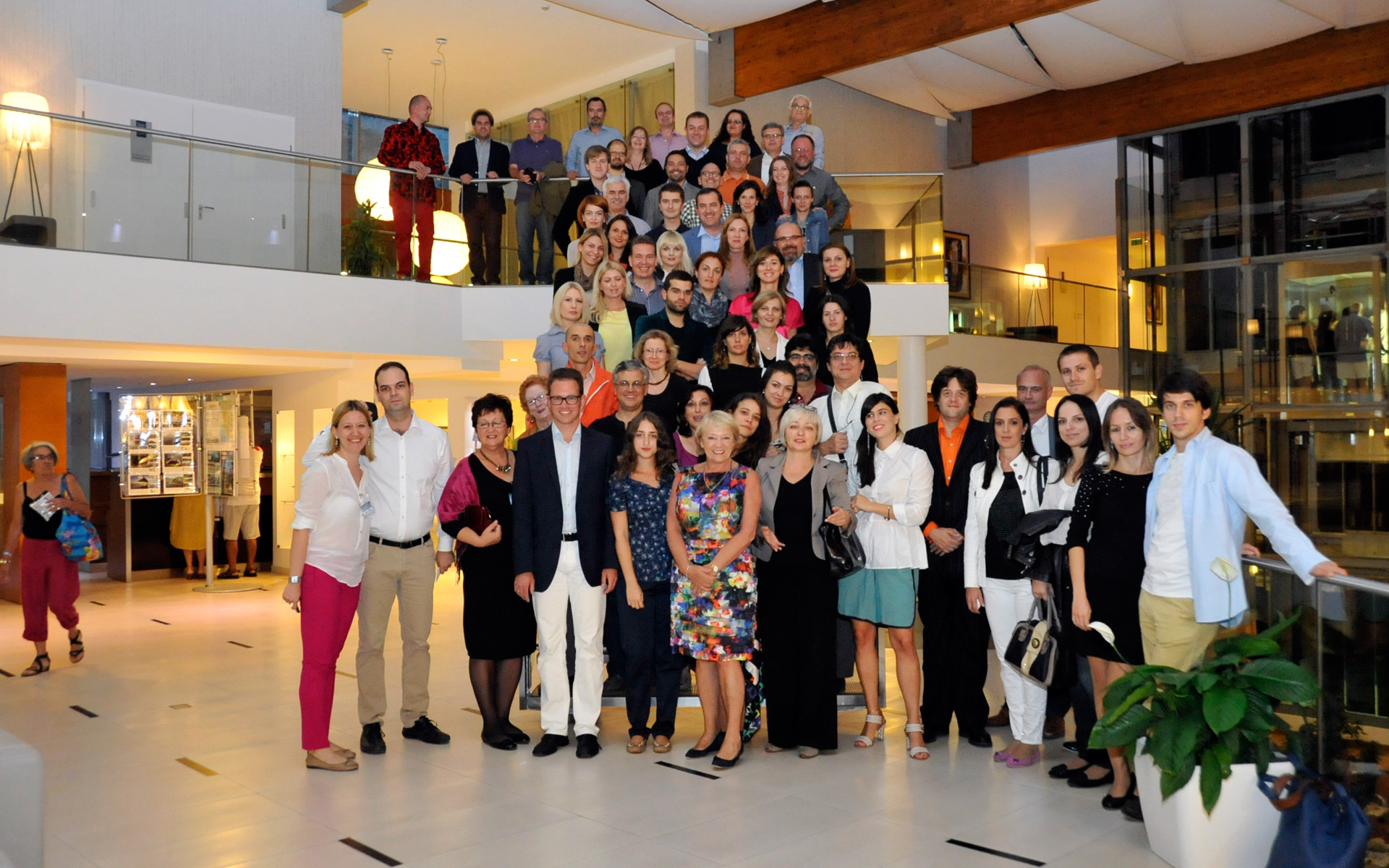
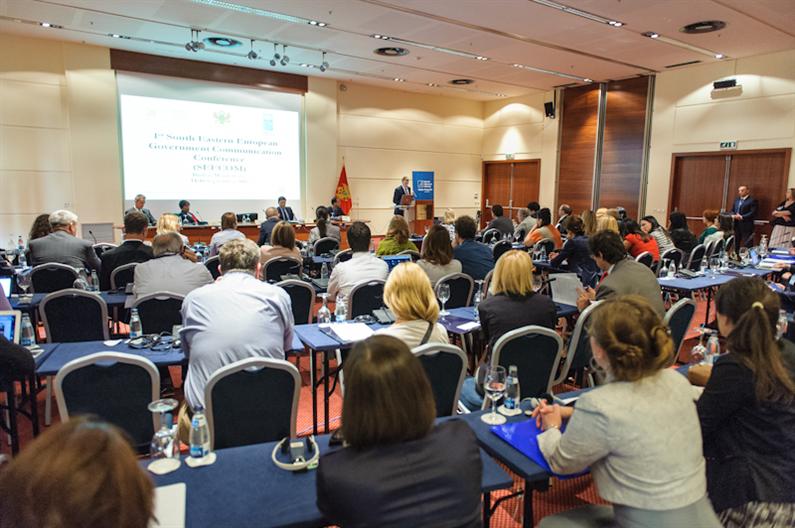
Participants at the second South Eastern European Government Communications Conference in Budva, September 2013
The second South Eastern European Government Communications Conference, Budva, Montenegro, September 2013.

The second South Eastern European Government Communications Conference brought together government communicators from 13 countries in the region. Discussions addressed public communication as a public service, communication resources, two-way communication, citizen participation, social media, EU affairs, the presentation of public policies and regional cooperation.

Participants adopted the Statute establishing SEECOM as a non-profit professional association based in Budva.

The conference was organised by the Government of Montenegro in cooperation with the US Embassy in Podgorica, the Konrad-Adenauer-Stiftung Media Programme South East Europe, the Regional Cooperation Council and UNDP Montenegro.


1st South Eastern European Government Communications Conference

14–16 September 2012 · Budva, Montenegro

Participants at the first South Eastern European Government Communications Conference in Budva, September 2012
The first South Eastern European Government Communications Conference, Budva, Montenegro, September 2012.

The first South Eastern European Government Communications Conference brought together officials from nine South East European countries and experts from Europe and the United States.

The conference adopted the Budva Declaration, setting out shared professional and ethical principles for government communication, and established SEECOM as a regional professional forum.

The event was organised by the Government of Montenegro, UNDP Montenegro and the Konrad-Adenauer-Stiftung Media Programme South East Europe. Welcome remarks were delivered by Prime Minister Igor Lukšić, US Ambassador Sue K. Brown, UN Resident Coordinator Rastislav Vrbensky and Henri-Giscard Bohnet, Head of the Konrad-Adenauer-Stiftung office.